
No Reviews, No Revenue: The Brutal Truth About Social Proof in Hospitality Tech
I've watched it happen more times than I care to count.
A hospitality vendor spends a small fortune getting in front of the right people — trade shows, sales teams, e-blasts, the whole outbound machine humming at full speed — and then loses the deal in a Google or AI-search that takes thirty seconds.
Not because their product isn't good (because, of course, it is!)
It’s because none of the online discovery engines can prove it is.
On the InnSync Show, my partner Cory Falter recently sat down with Kassandra McLaren and James Alan of Monty Reviews to talk about what happens when your social proof doesn’t exist.
What started as a conversation about social proof for your hospitality company turned into something closer to a mirror. One that most vendors in this industry probably don't want to look into, but absolutely need to.
Social Proof for Hospitality Vendors
The Feature Dump Nobody Asked For
Here's the scene Kassandra described, and it's painfully familiar: a vendor walks into a sales conversation armed with a deck full of product features.
They know their tech inside and out.
They're ready to impress.
And they completely miss the point.
"The biggest mistake they make is jumping right into a data dump about the features of their product," Kassandra said. "Without creating that social proof and really dialing into what their customer wants, their customer's challenges, their customer's pain points."
This isn't just a messaging problem. It's a sequencing problem. Features don't build trust. Proof does. And proof has to come first, before the pitch, before the demo, before you've said a single word about what your product does.
James put it another way: leading on the front foot isn't about launching into your value proposition. It's about showing up to listen. "We don't want to come in and consume people," he said. "Putting up too many barriers to entry can obviously stop that relationship from being built from scratch."
The vendors who win aren't the ones with the slickest slides. They're the ones who've already done the work of proving they're worth talking to, before the conversation even starts.
The $100,000 Blind Spot
Here's where it gets expensive.
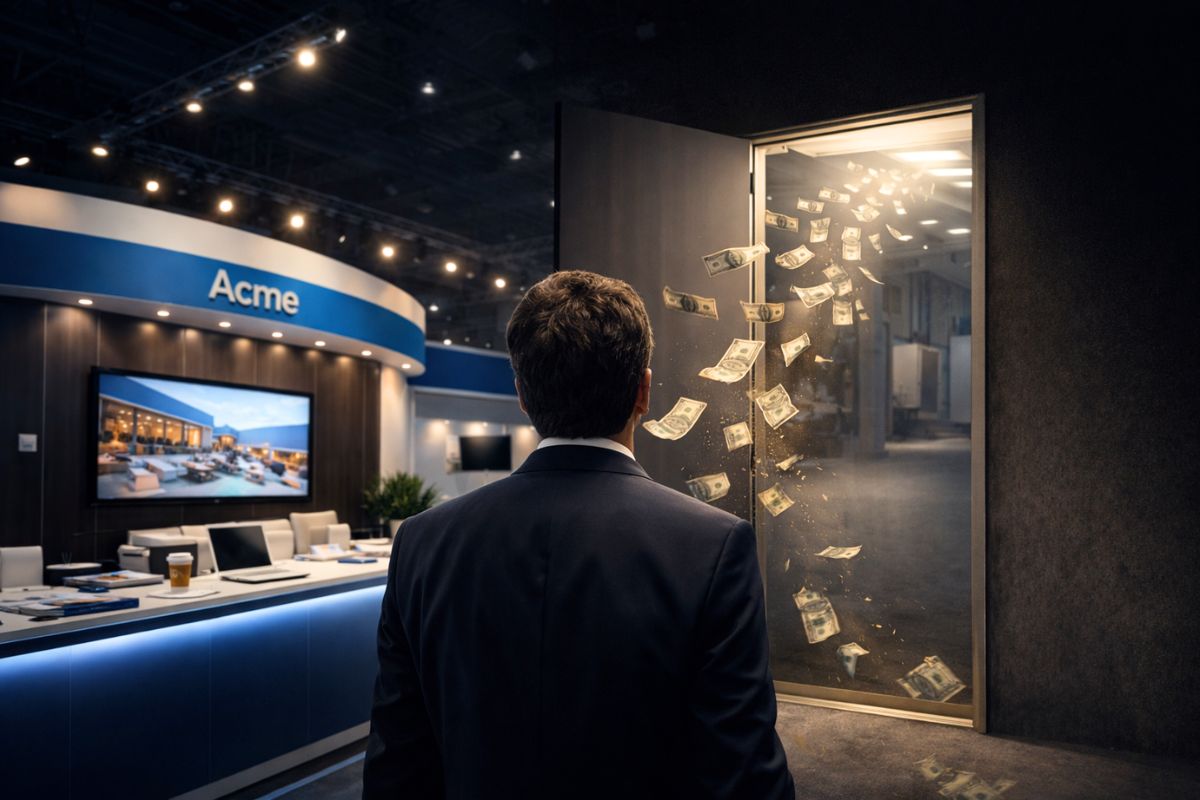
We see companies spending six, sometimes seven figures on trade show booths, exhibiting fees, and sales headcount to start conversations with prospective buyers.
And I get it. Those conversations matter.
But here's what's happening next, and it's costing deals: The prospect gets on the plane, flies home, sits down at their desk, and Googles you.
And if what they find online doesn't match the energy from the room? You just burned your entire investment on a first impression that didn't survive the flight home.
Cory made this point directly during their conversation: "They go, wow, maybe we should vet these guys online. Find out what if they're really about. Lo and behold, their in-real-life person experience does not line up with their online profile."
It gets worse. The rise of AI-powered search means that when someone types your company name into ChatGPT or Perplexity, one of the first things that surfaces is reviews and testimonials. These are now primary trust signals in AI-generated responses, not just nice-to-haves sitting on a forgotten page of your website.
Outbound strategy without an inbound presence isn't a sales strategy. It's a leaky bucket.
What "Strong Social Proof" Actually Looks Like
Let's get specific, because "get more reviews" is advice as useful as "just be more confident."
Kassandra broke down a framework she's used across sales and customer success teams for years:
- start by documenting your champion clients' goals, their emotional goals (the value statement)
- and their quantifiable wins (the impact message)
Together, those two things become the story you tell the world.
For Monty, that story looks like this: one hotel client had 54 unhappy guests and zero bad public reviews to show for it. That's not a feature. That's a result. And results are what close deals.
"Show them the outcome," Kassandra said, "and then utilize those champion clients, because that builds that trust."
Here's a mindset shift worth sitting with: if your product genuinely helps people, staying quiet about it isn't humility. "If your product is really gonna help someone," Kassandra said, "it's actually being selfish not to tell them about it."
James added something that stuck with me, the idea of building in public. The most successful vendors right now are the ones lifting the hood and letting people follow the journey. Not just the polished case studies, but the story from January to June to year-end. People don't just buy products. They buy into narratives.
Three Moves Hospitality Vendors Can Make in 90 Days
If you have no reviews, patchy testimonials and website that looks like nobody's home. Here's how to fix it fast:
1. Ask for a Video Testimonial from Your Champion Clients
Document their goals in your CRM, build the value statement and impact message, and get them on video.
Even a rough, authentic clip of a happy client talking about their results will outperform a polished brochure every time.
Kassandra's advice: write the testimonial for them, then let them put it in their own words. You're removing friction, not manufacturing spin.
Make that video work everywhere. YouTube is vastly underused in this industry, and it's now a critical signal in AI search results.
A dedicated channel with client success stories, company milestones, and even behind-the-scenes moments does double duty: it builds trust with prospects and compounds your discoverability over time.
James openly admitted regretting not documenting Monty's expansion into Singapore, Bangkok, Cape Town, and beyond. Those were stories worth telling. Don't make the same call.
2. Create a Sizzle Reel and Anchor Your Website With It
Take your top three video testimonials and cut it like a Hollywood trailer: fast edits, music, energy, real quotes. Put it on your homepage.
This is your proof of life, and it does the vetting for you before a prospect ever picks up the phone.
We built a self-serve video portal that makes recording a testimonial nearly painless for clients.
Two minutes, a script prompt, done. That's the bar to aim for.
You've built the proof. Now make sure the internet knows it exists.
Here's Lure Agency's Sizzle Reel...
3. Put Your Own Proof on Trial
Now stress-test everything you just built.
Pull up ChatGPT, Perplexity, Claude (or your AI tool of choice), clear the memory for an unbiased result, and search your own company name.
What comes back is exactly what your next prospect will see.
If it's thin on social proof, or surfaces a complaint with nothing to counter it, that's your next 30 days mapped out for you. One negative review carries the weight of ten positive ones. The stress test isn't the last step. It's the step that keeps the other two honest.
This Is Where Most Vendors Drop the Ball
The tools exist. The frameworks are proven. The only thing standing between most vendors and a pipeline full of warm, already-convinced prospects is the willingness to do the unglamorous work of capturing proof, consistently, systematically, and early.
Kassandra, James, and the team at Monty Reviews are building exactly this kind of infrastructure for hotels: capturing guest sentiment in the moment, driving reviews at peak satisfaction, and helping properties climb from 3.5 to 4.4 stars in under six months. If you're in hospitality and want to see how they do it, find them at montyreviews.com or connect on LinkedIn.
And if you're a vendor watching your outbound numbers plateau while your online presence sits dusty and unattended, you already know what to do next.
Ready to Turn Your Social Proof Into a Sales System?
Everything we talked about in this article, the champion client framework, the video testimonials, the sizzle reel, the self-audit, that's not a checklist. It's a strategy. And strategy works best when it's built into how your whole team operates.
At Lure Agency, we built the WINS Method specifically for hospitality vendors who are tired of outworking their results. WINS is a four-part framework designed to bring clarity, confidence, and consistency to the way your team shows up and sells, without the sleaze, the guesswork, or the one-size-fits-all nonsense.
If the ideas in this post resonated, there's a good chance WINS is the missing piece between where your pipeline is today and where it should be.
Come take a look at lureagency.com/the-wins-method and see if it feels like the right fit.
Social Proof for Hospitality Vendors FAQs
1. Why aren't my hospitality sales closing after trade shows?
Most deals that stall after a strong in-person meeting fall apart during the online vetting stage. If your reviews, testimonials, and social proof don't hold up to a quick search, the trust you built in the room evaporates the moment your prospect gets back to their desk.
2. How do I get hotel clients to leave video testimonials?
Make it as painless as possible. Write a draft for them, give them a simple prompt, and keep the ask under two minutes. The easier you make it, the more likely they are to follow through. Capturing them at the highest point of satisfaction, right after a win, makes the yes even easier.
3. Do online reviews really affect B2B hospitality tech sales?
Yes, and more than most vendors realize. AI-powered search tools like ChatGPT and Perplexity now surface reviews and testimonials as primary trust signals when buyers research vendors. A thin or negative review profile can quietly kill deals that your sales team never even knows it lost.
4. What is a video testimonial sizzle reel and do I need one?
A sizzle reel is a short, high-energy compilation of your best client video clips, edited like a movie trailer with music, fast cuts, and real quotes. It gives prospects an immediate emotional read on your credibility. Anchored on your homepage, it does the vetting work before a buyer ever reaches out.
5. How do I know if my company's social proof is strong enough to close deals?
Run your own company name through an AI search tool with a clean, memory-cleared session. What comes back is exactly what your prospects see. If the results are thin, generic, or surface a negative review without a strong counter-narrative, you have your answer and your action plan.