
How One Simple Form Change Drove 50% More High-Converting Direct Leads
Hotels have a friction problem.
Not the kind you fix with a renovation budget or a rebrand.
The kind that lives inside your RFP form, your response time, your website's blank stare when someone shows up with a question and leaves with nothing.
The kind that quietly empties your event pipeline while you're busy wondering why leads have dried up.
Cory Falter, founder of Lure Agency, has spent years studying how independent hotels win and lose meetings and events business. Don Barnett, Director of Sales and Marketing at LondonHouse Chicago, has lived it from the other side.
Together, they make a convincing case that the industry's biggest conversion problem has nothing to do with rate, location, or the hotel down the street.
"It's not your comp set," Barnett says. "What we're competing with is every other buying experience that meeting planners have now."
He means Amazon.
He means the checkout experience so smooth you barely notice money leaving your account.
He means a world where someone can order a Queens of the Stone Age vinyl record from their phone and have it on their doorstep by dinner.
That is the benchmark your RFP process is being measured against, whether you like it or not.
You're Not Losing to the Marriott. You're Losing to Expectations.
The hospitality industry has spent decades designing its sales process around what's convenient for the hotel.
Detailed RFP forms that front-load every question sales teams might eventually need.
Intake flows that assume every person landing on your meetings page already knows what attrition means, has firm dates locked in, and is ready to submit a complete brief before anyone picks up the phone.
That assumption is wrong about half the time.
Cvent's own planner guides acknowledge a whole category they call 'occasional or part-time corporate planners,' people whose job titles range from executive assistant to marketing manager, who organize events on an ad-hoc basis.
Lure Agency's data across client properties suggests this group may account for as much as half of all inbound meeting inquiries
They're executive assistants, office managers, and department heads who had the job handed to them when their company decided not to rehire a dedicated meeting planner after COVID.
They have a boss who wants an executive sales retreat for a hundred people in Chicago. They have no idea where to start. And they are stressed.
Falter calls her Sally Sue.
Sally Sue lands on your website. She is looking for basic answers, a sense of who she'd be working with, some indication that this hotel understands her situation.
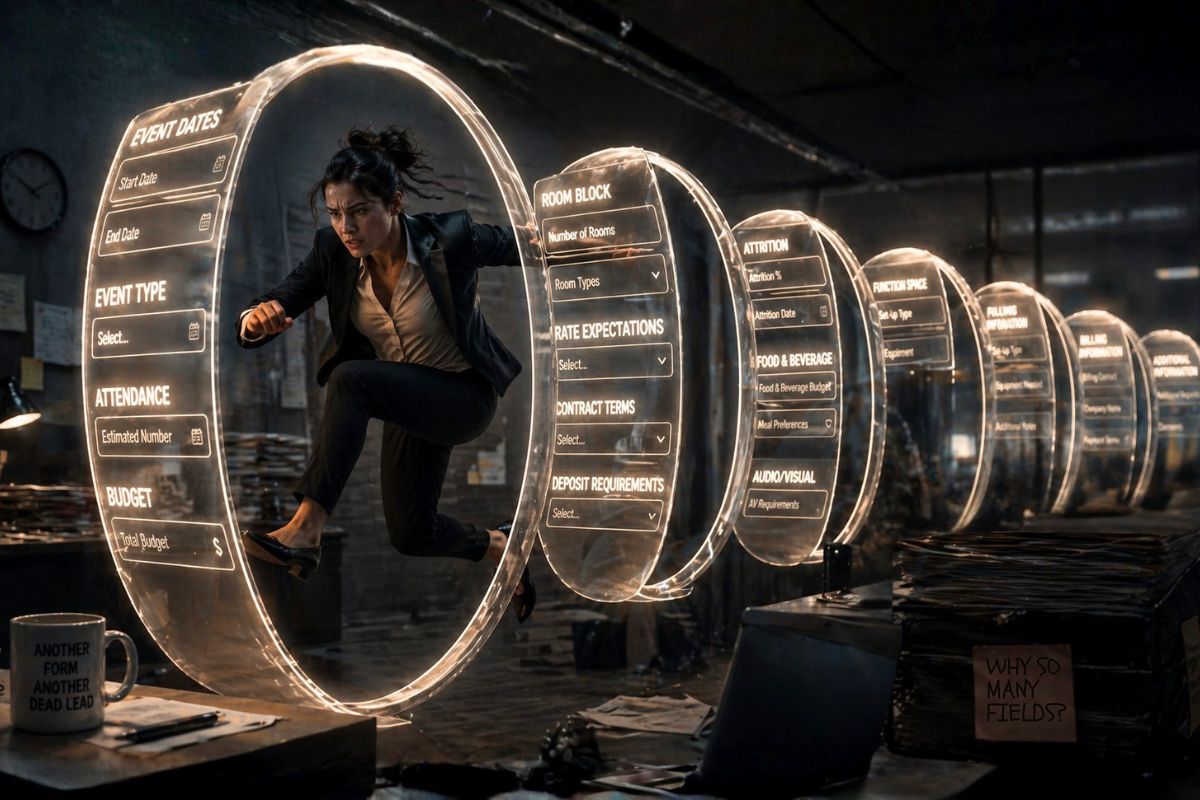
Instead, she finds a form with 50 fields asking for information she does not have.
No team photos.
No FAQs.
No pricing framework.
Just the form.
She bails.
"That's how it's happening so often," Falter says. "And we know this because lack of traffic on hotel websites is not the problem. It's when people go to the website, they're not seen, and they're met with friction."
The traffic is there. The intent is there. The opportunity evaporates at the exact moment the hotel puts process ahead of the person.
What a Shorter Form Did to Lead Volume for LondonHouse Chicago
LondonHouse Chicago tested something simple.
They kept their existing detailed RFP form live on the site and added a second, much shorter option. Name, contact information, and one open field: how can we help?
That month, leads increased by 50%.
Not by redesigning the website. Not by launching a new campaign. By giving people a low-barrier way to raise their hand.

"We've reduced that friction of needing specific information," Barnett explains, "and now people can reach out with more general stuff, which is leading to more conversations and being that trusted advisor that people are looking for."
This matters more than most hotel sales teams realize, partly because of the volume impact and partly because of what those leads actually convert at.
Third-party RFPs submitted through platforms like Cvent are distributed to dozens of hotels simultaneously. The average conversion rate on those sits between 3 and 5%.
Direct inquiries coming through a simple website form, the ones where someone reached out specifically to your hotel, convert at 35 to 55% in Lure Agency's research across their client properties.
The math is uncomfortable. Teams spending hours crafting proposals for Cvent leads who win at 4% are ignoring a channel that wins at 10 times that rate because they haven't made it easy enough for that channel to exist.
There is also the commission question. Direct inquiries are not commissionable. Every piece of business that walks through your digital front door without a third-party intermediary is margin you keep entirely.
"It's almost like you're pushing them out the door and forcing them to go through somebody else," Falter says, "when they're already through the doors of your hotel."
Speed Is a Strategy, Not a Courtesy
Once the lead comes in, the clock is ticking faster than most hotel teams appreciate.
Meeting Broker analyzed response patterns across thousands of RFPs and found that 72% of the time, the first hotel to respond wins the business.
Not the cheapest.
Not the most luxurious.
The fastest.
Barnett took that data seriously. He set a team goal of responding within four hours. LondonHouse now averages 4 hours, down from a comp set average of 5.3 hours, and ranks first in their market for both conversion rate and awarded business value.
"If you're waiting till the next day to get back to somebody," Barnett says, "there are already probably 10 hotels that are way ahead of you, and you're not even going to be in consideration. And it doesn't even matter how good your rate is at that point."
Speed signals something beyond efficiency. It tells the planner that this hotel is organized, attentive, and likely to execute the event the same way.
Friction in the booking process, whether it shows up as a clunky form or a slow callback, plants a seed of doubt about what the event itself will feel like.
"Friction kills confidence," Barnett says. "If your process to book business is complicated or messy, you're going to lead them to an assumption that the event execution might be that way as well."
That reputational effect compounds. Planners talk. "One person's experience is another person's proof," Barnett notes, "and if it was very difficult to work with you, they're gonna text three of their colleagues and say this hotel is a real pain to work with."
Five Things That Remove the Friction Before Anyone Picks Up the Phone
The short form is the starting point, but it is not the whole picture.
Falter and Barnett outline a set of changes that work together to reduce skepticism and convert interest into booked business.
- A short contact form on the meetings page.
Not instead of the detailed RFP, alongside it. Give people a way to start a conversation without requiring them to finish it in one sitting. - A deep FAQ hub.
Not spa hours and restaurant reservations.
The actual questions a first-time event planner asks at midnight: What is attrition? What does AV typically cost? What's included in a room rental? AI can help generate this content, and it also makes the site more visible in the kind of conversational, question-based searches that now dominate how people research venues.
On that note, a blog post that answered questions about LondonHouse's rooftop buyout was the origin point of a roughly $50,000 lead that came through Google search. The planner found the blog, got their questions answered, and filled out the short form. That is content doing sales work. - Team pages with real faces.
Knowing who you'll be working with reduces the perceived risk of reaching out.
A sales manager's headshot and a two-line bio does more trust-building than any award logo on the homepage. If your executive chef has a personality, show it. - Video testimonials.
Written reviews are fine. Video testimonials do something different. Watching a real planner describe a successful event at your property collapses skepticism in a way that a star rating cannot. - A pricing framework.
Not a rate card. Not a promise. A range, a starting point, a sample event breakdown that gives someone a realistic sense of whether they're even in the right ballpark before they invest time in a formal inquiry.
Hotels that are willing to have this conversation openly signal trustworthiness. Hotels that hide every number behind a form submission signal the opposite.
What Happens When the Friction Goes Away
LondonHouse operates in what Barnett describes, with characteristic understatement, as two seasons: busy and crazy busy.
The conversion data backs that up. A 10 to 14% conversion rate on third-party RFPs in a market where the norm is 3 to 5%. Direct inquiry conversions multiples higher than that. A response time benchmark that the comp set hasn't matched. And a lead that traced back to a blog post.
But the most durable outcome is harder to measure. It is the planner who had such a smooth experience the first time that the next time they have a meeting in Chicago, they skip the RFP process entirely and call Don directly.
"I loved working with this hotel," Barnett describes. "If I have a meeting in Chicago, I'm calling Don first because it was so easy to work with him. And that's a real thing. Some people just decide they want to work with this person from now on."
That is not a conversion. That is a relationship that bypasses the entire competitive process, indefinitely.
The industry has spent years treating friction as a feature, a way to filter out unserious inquiries and gather clean data upfront.
What LondonHouse demonstrates is that friction filters out far more than it filters in. It filters out Sally Sue, who is stressed and flexible and has already decided she wants to call one or two hotels directly instead of blasting an RFP to forty. It filters out the planner who just wants a rooftop for midweek in August and doesn't need to fill out a form to check whether you have it.
The hotel that makes it easiest to say yes wins the business. Not sometimes. According to the data, most of the time.
Behind the Numbers
LondonHouse Chicago works with Lure Agency, and the results in this article came directly out of applying The WINS Method™ to their meetings and events sales process.
The short form, the FAQ hub, the blog that turned into a $50,000 lead — none of it is accidental.
If your hotel is leaving business on the table, The WINS Method™ is where to start. Click below to learn more.