

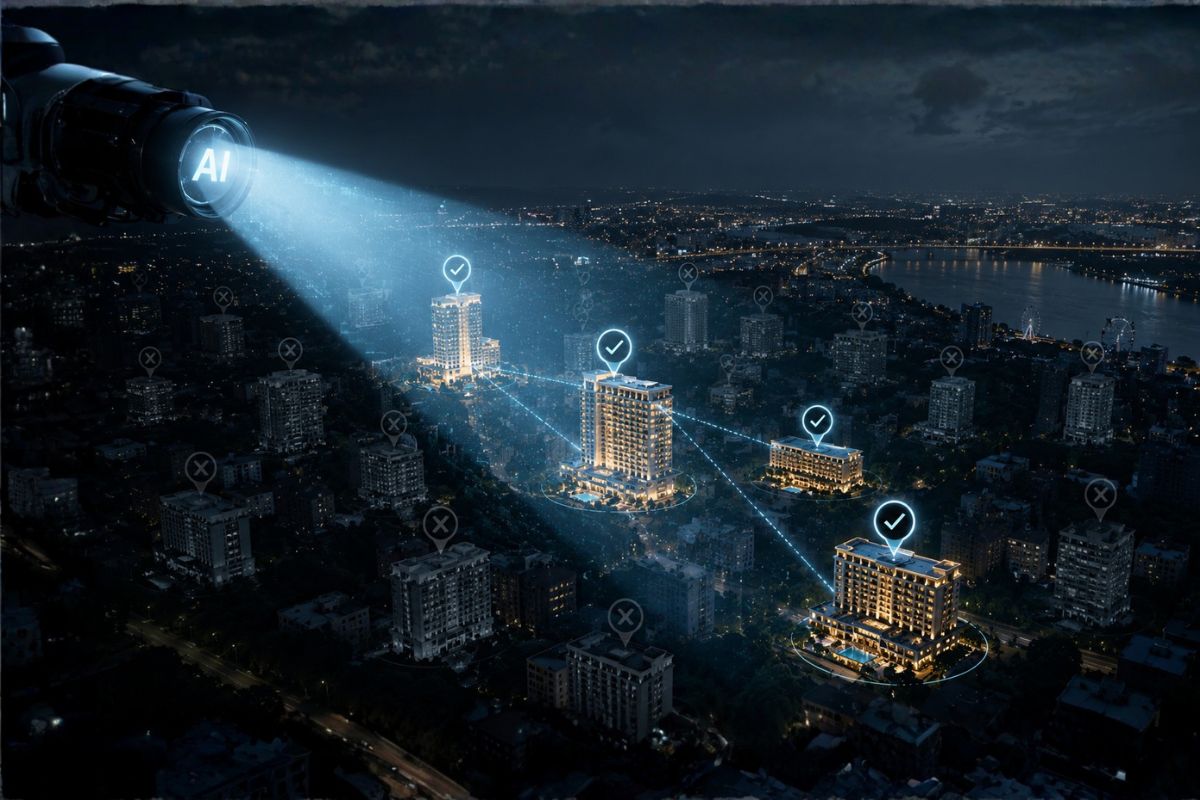
And why most hotels won't make the shortlist before they even know it exists.
Hotel sales teams have a problem they don't know they have.
It's not that planners are choosing competitors.
It's that their property isn't making it to the conversation at all.
The shortlist is being built before the RFP goes out, before a salesperson picks up the phone, and increasingly, before a human being is involved in the decision at all.
Meeting planner David Moore, founder of Moore Style Events, a boutique firm specializing in biotech and tech events, is one of the people helping build it.
He sat down with Cory Falter on the InnSync Show to break down exactly how AI has changed his sourcing workflow and what hotel sales teams need to hear, whether they're ready to or not.
The Old Way Took Hours. The New Way Takes Minutes.
Not long ago, sourcing a venue meant opening ten browser tabs, logging into Cvent, cross-referencing maps, and hoping that the information posted on a hotel's website was accurate and specific enough to answer the actual question being asked.
Moore's team works with clients who run technically demanding events. A lot of their client equipment is large. For biotech events, especially, that means one non-negotiable requirement: can you drive a car into the venue?
"Sourcing that has been huge for us," Moore said. "Lots of hotels have venues that are on second floors that don't have elevator access, or maybe don't have a door that's large enough in their ballroom or convention space."
Cvent doesn't have a filter for that. Neither does HopSkip, which Moore calls his preferred traditional platform. What AI can do is take a 10-point criteria list and cross-reference it across properties in minutes, surfacing options that would have taken hours to find manually, or might never have surfaced at all.
The speed advantage compounds. Clients call with a city and a timeframe. Moore's team needs to respond fast with smart options. "We have 10 criteria that we can then put into an AI system," he said, "and we can get that information much faster and turn it around to our clients much faster."
That turnaround used to take days. Some of it still does, on the hotel's end.
"Three Miles From the Convention Center" Doesn't Mean What You Think It Means
Distance is one of the most consistently misleading pieces of information in hotel marketing copy.
Three miles sounds manageable. Three miles through Vienna at 11 p.m. after a conference dinner, looking for a private room that seats 50 and stays open late, is a different experience entirely.
Moore’s team recently faced that exact scenario. They needed “a restaurant that is open late, that has a private room, that is near the hotel, that can host 50 people.” In the past, that meant spending an hour with Google Maps. With AI, Moore said, the same search can happen in minutes.
AI doesn't just accept the stated distance. It plots locations, accounts for transit, checks proximity to airports and train stations, and validates what "close" actually means on the ground.
Floor plans, room dimensions, ceiling heights, load-in access, internet infrastructure: these are the specifics that determine whether a venue is viable. Hotels that publish vague or incomplete information about these details aren't being humble. They're being invisible.
How does your hotel stack up? Check out our Hotel Visibility AI Grader >>
The Trust Problem That Shows Up Before You Do
Here's where it gets personal.
Falter shared a story that should make every hotel sales professional uncomfortable. He was referred to an insurance agent by a trusted friend. The referral was strong. The relationship behind it was solid. Before picking up the phone, Falter ran the agent through ChatGPT.
"Their online reputation did not match with what my friend told me about them," he said. "It changed my mind. I ended up not using this particular agency and went in a completely different direction based on what ChatGPT told me."
A warm referral, killed by a digital footprint. Or rather, by the absence of one.
This is already standard practice in service industries where expectations are high and mistakes are expensive. Six-figure event contracts fall squarely into that category. Meeting planners are already vetting hotels, sales teams, and AV crews using AI before reaching out. Moore's team does it explicitly: "We'll vet them on AI as much as we can, and then go to LinkedIn, find their mutual connections, and see if any of those are ours."
What AI is pulling when vetting a hotel team: LinkedIn activity, review patterns, published commentary, and industry presence. Not just what a hotel says about itself, but what the broader internet says about it, which is a harder thing to manage and much harder to fake.
A SEMrush analysis of 325,000 unique prompts across ChatGPT, Google AI Mode, and Perplexity found that LinkedIn was the second-most-cited source in AI-generated answers, behind only Reddit. Separately, research from Profound ranked it the most-cited domain for professional queries. That's not a soft metric. That's the algorithm deciding whether you exist.
Moore put it plainly: "I honestly don't understand hotels that are not on LinkedIn."
The Referral Isn't the Finish Line Anymore
The word-of-mouth referral used to be the gold standard, and it still carries weight. But it no longer closes the loop.
What's changed is the verification step. Buyers don't just receive a referral and act on it. They confirm it. They triangulate. They ask AI whether the enthusiasm matches the record. And if the record is thin, or worse, contradictory, the referral loses its power.
For hotels, this changes the calculus around sales effort. A salesperson can build a strong relationship at a conference, exchange cards, follow up perfectly, and still lose the business if the property's online presence doesn't support the story being told in person. "If your online reputation does not match up with what you show up offline," Falter said, "it's all for naught."
The properties with detailed websites, active sales teams on LinkedIn, published thought leadership, and genuine response to online reviews are building trust signals that AI reads and reports. The ones that aren't are generating silence, which AI interprets as a reason to keep looking.
What Actually Gets You on the Shortlist
There are specific things hotels can do, and Moore and Falter are explicit about them.
Put the operational details online. Not in a PDF. Not in a sales kit that lives in a shared drive. The information needs to be crawlable and findable: room dimensions, door widths, AV infrastructure, internet capacity, proximity data that's actually accurate. If your ballroom can fit a 7-series through the loading dock, say so online. That specific detail is the kind of thing that builds a shortlist.
Hotel teams also have a workaround available even when their own websites fall short. A salesperson who publishes consistently on LinkedIn, including venue-specific details and differentiators, is creating content that AI can surface. Falter is direct about this: "As a seller, you could go online on LinkedIn and start talking about that as a differentiator."
Speed matters more than hotels typically treat it. Moore's clients expect answers fast. Not 24 to 48 hours. The comparison he draws is to e-commerce: Amazon has trained buyers not to wait. An RFP that goes unanswered for two days in a world where AI can generate a ranked shortlist in two minutes is a sales process operating in the wrong decade.
Finally: the team is part of the product. A venue that checks every box but has no visible, credible sales team online is a risk. Moore's team vets the humans behind the hotel the same way they vet the hotel itself. Planners want to know who they're calling before they call.
Catching Up to a Process That Already Left
The planners who are using AI well aren't doing anything exotic. They're answering the same questions that have always mattered in venue selection: Does it fit? Is it close enough? Can we trust the team? The difference is that those questions are now being asked and answered before anyone sends an email.
"Did you Google that?" used to be the standard. Moore laughed about the shift: "Now we say, 'Did you run that through AI and see what you could find?'"
For hotel sales teams, that shift is already in motion. The shortlist is being built right now, with or without them. The properties that show up are the ones that have made themselves legible to the tools doing the sorting: specific, credible, visible, and fast. The ones that haven't are getting filtered out before the conversation starts.
Not rejected. Just never considered.
Your Website Is Either On the Shortlist or It Isn't
Everything David Moore described points to the same root problem. Most hotel sales teams don't have a system that makes them findable, credible, and specific enough to survive an AI-generated shortlist.
That's what Lure Agency's WINS Method addresses. A hospitality-first framework that starts with a four-session workshop, then gives your team the tools and support to execute it consistently.
The “W” alone is worth the conversation. If your website isn't answering the questions planners are feeding into AI, you're already filtered out.
See how the WINS Method works at lureagency.com