

Meeting Planners Book Proof, Not Ballrooms
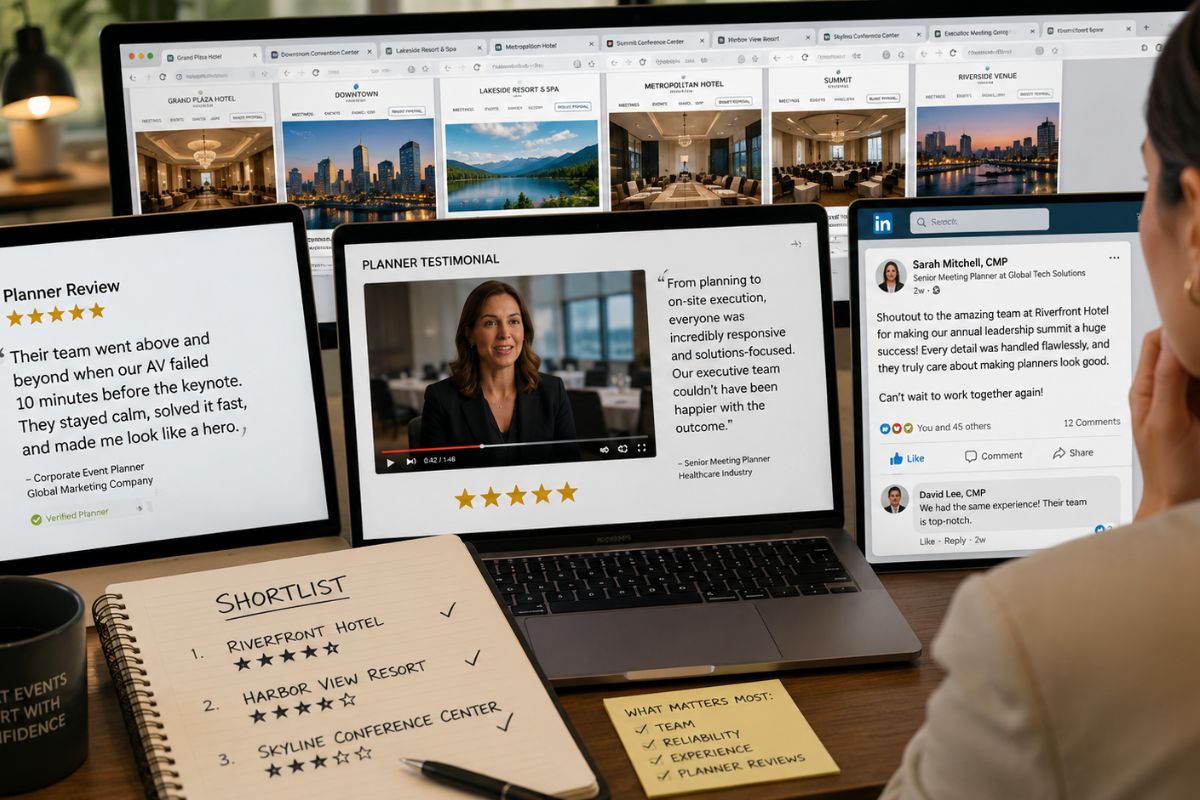
A corporate planner with a $40,000 budget and a nervous boss opens a dozen browser tabs. She isn't reading your brochure. She's hunting for the planner who booked you last spring, the one who can tell her whether your team kept its cool when the AV died ten minutes before the keynote.
By the time she submits your RFP, she has already decided how much risk you represent. You just don't know it yet.
That silent pre-decision is the whole ballgame, and it's the subject of a recent episode of the InnSync Show. In this episode, Cory Falter and Susan Tucker make a solid case for something most conference hotels treat as an afterthought: social proof.
As Cory says, "Meeting planners don't buy meeting space; they buy confidence."
Social Proof for Group Sales? Absolutely!
The Leisure Side Gets It. The Meeting Side Is Asleep at the Front Desk.
Walk into a beach resort, and you'll trip over the review machine at check-in, the little tablet begging you to rate your stay before you've even found your room key.
The leisure team is obsessed.
Susan says hotels on the leisure side live and die by TripAdvisor and Yelp, "but the meeting venues are not doing it."
That neglect is expensive, and for two reasons that didn't exist a decade ago.
The first is human, and it's as old as commerce.
Robert Cialdini called it social proof: when we're unsure, we copy people who look like us.
A planner deciding where to drop six figures isn't reassured by adjectives; she's reassured by another planner who survived the same decision.
And that is your best advocate. A review from another planner carries so much more weight than a brochure.
We've all built up scar tissue against marketing copy. "We are all becoming numb to the glossy brochure," Susan says. Nobody believes the drone footage of the empty ballroom anymore.
The second reason is brand new. AI now sits between your venue and the buyer.
Ask a generative search tool to recommend conference hotels in a city and watch where it pulls its answers: aggregated reviews, third-party profiles, video transcripts, the chatter humans left behind.
Susan notes that AI "is increasingly surfacing reviews in their search results." Your brochure is invisible to a language model.
Then there's the buyer you didn't plan for.
Cory points to research Cvent has cited suggesting that half of corporate meetings are "simple," replicable events, the kind typically handed to people who plan by accident, the executive assistants and office managers given a budget and a deadline. They have zero pattern recognition for what a good venue feels like, so they outsource the decision to whoever left a five-star review.
More dollars on the line, fewer professional planners holding the pen, and a robot reading your reviews before any human does. That's the table you're playing at.
Why a Happy Client Walks Out Without Leaving a Word
Much of the time, the event goes great, the CEO is grinning, and the venue still ends up with nothing in writing.
Cory has a theory….
The moment the last attendee files out, the team exhales. "Oh my gosh, we're completely exhausted," and asking for a review in that fog feels like one more chore, or worse, like a sales move you have to make to someone you just spent three days serving.
Then comes the handoff. Sales booked the group and mentally moved on to the next one. Convention services ran the show. Each assumed the other would handle the ask.
"Sales may have thought that convention services were handling it. Convention services thought that sales was handling," he says, and in the gap, the review quietly dies.
Susan refuses to pin it on the people. "You can't really blame the people; you blame the process," she says.
No standard operating procedure, no owner, no trigger.
The review doesn't get missed because anyone is lazy. It gets missed because nothing in the workflow ever says now.
Her fix is a phrase she returns to so often it becomes the episode's refrain: "It's about removing the friction and just making it a part of the process."
Build the ask into the SOP, and the awkwardness evaporates, because nobody has to remember to be brave.
Ask While the Room Is Still Warm
Timing is key.
"You really don't want to wait until three weeks after the event or after the invoice or during checkout," Susan says.
You ask at the peak.
"Anytime the executives are complimenting the team, when they're still talking about the experience, they're excited, they just got finished, they've got all these ideas and they're bursting with all this good energy, capture that, it's an emotional moment."
Psychologists call it the peak-end rule: people judge an experience by its emotional high point and its final moments, not its average. Catch a planner at that peak, and you capture the most generous version of the truth they'll ever offer. Wait, and the memory flattens into "it was fine."
Cory would even push this further. He says, “If you can read the room mid-event, the planner sinking into a chair with a relieved smile, the energy in the general session climbing, that's your cue too.”
And if you whiff on the moment entirely? "Not all is lost if the event is over and off the property," he says. The follow-up still works, which brings us to the part where you stop relying on luck.
Hand Them the Pen, Not a Blank Page
Ask a thrilled planner for a review, and you'll often get six words back: "It was great, the team was fantastic." An open-ended ask puts the work on a busy person and gets you mush.
The hosts' answer is to script the story without scripting the words.
Cory borrows the hero's journey, the three-act arc behind nearly every movie you love, and turns it into three questions.
- Start with the stakes: "What challenges were you trying to solve prior to this event?"
- Move to the choice: “Why this venue, and what was the team like to work with?”
- Land on the payoff: “How did the event go, and did you hit your goals?”
Keep the whole thing under two minutes, "short and sweet, and handhold them through that process."
It works because it flips the camera.
The hero of a great testimonial is never the hotel. It's the planner, the one who looked brilliant in front of her boss because your team caught the curveball.
Marketers call this the "customer as hero" frame, and it's why a structured prompt outperforms a comment box every time.
You're not fishing for praise; you're helping someone tell a flattering story about themselves that happens to feature your ballroom in the background. You've practically written it for them.
The Toolkit: Links, Reciprocity, and a Blitz
Here are a few tactics you can use right away to start building that review library.
1. Start with the safety net
If you miss the live moment, your follow-up email carries a single link to leave a review.
Susan and Cory went further and built a page that does the heavy lifting: a recipient clicks, a video pops up that walks them through five questions, and they upload their answer in one shot.
Susan mentions they "vibe coded" the thing themselves, which is its own quiet lesson about how easy this has gotten. Anyone can try this tactic.
The same capture lives inside RevlyCRM, the hospitality CRM which automates the ask so a human never has to feel like a telemarketer.
2. Then comes the move that doubles your money
Take the video transcript, pull the three or four sharpest lines, and send them back to the planner so they can just paste.
Most people will never carve out an hour to write a testimonial from scratch, but as Susan observes, "they will happily edit one."
Drop those polished quotes onto a high-authority third-party review site, the kind AI loves to cite, and one video becomes a website testimonial, a search signal, and a profile review.
One ask, three assets.
3. The favorite is reciprocity
Feature your client's gala on LinkedIn, tag the planner, celebrate the win publicly, then ask for a review in return.
"You give, you get," she says.
Cory compares it to the Uber rating system, where the driver rates you back, and notes that a review left for someone on LinkedIn almost always boomerangs back as one.
Be direct about it: "I'd love to leave a review for you. I know you're looking for new business as well."
Then, in real time, the two of them invent a tactic on air. Block a day each month, call your last ten planners, and knock out a batch of mutual reviews together, maybe five of you on a Zoom doing it at once. Falter christens it on the spot. "Review blitz. Bam." It's the only sales blitz that makes everyone richer.
From Four-Minute Monologue to Movie Magic
How can you turn raw testimonials into a marketing asset prospects will watch?
Turn them into a movie-style Sizzle Reel, splicing the best lines from many guests into a single highlight tape.
Lure runs one on its homepage. Their client, Windrose on Hudson, hosts one on YouTube, which is deliberate because YouTube is a signal both Google and AI reward.
Crucially, none of it is fabricated. The words belong to the client. "It's their words, we're just making it like movie magic," Susan says.
Want the budget version? Pull one killer quote, set it on a clean background, and post the static image. The video component is the gift that keeps on giving because every downstream format starts from that single recording.
What the Planner Is Really Telling the Next Planner
Go back to the woman with twelve tabs open. Notice what she's scanning for. Not square footage. Not ceiling height.
That's the insight Susan saves for the close.
"The best reviews, they don't talk about the ballroom ceilings," she says. "They tell the story of what made their important meeting or retreat or client party successful. They want to talk about your team."
A planner reviewing your venue is doing something larger than rating a room. She's "telling the next planner whether your team made them look like a hero." The architecture is table stakes. The reassurance is the product.
Cory ties it to the framework Google built its entire trust system around, the four letters quietly governing which sources AI decides to believe: Experience, Expertise, Authoritativeness, and the one that closes business, Trust.
Every review you bank is a deposit in that account. Every video testimonial is interest on top.
Somewhere out there, a planner is deciding between you and the property across town, and she's making that call right now based on what other people said when you weren't in the room. The only variable you control is whether you gave those people the chance to say it.
Remove the friction, ask while the room is still warm, and hand them the pen. The shortlist of three to five has room for venues that figured this out. It's running out of patience for the ones still printing brochures.